
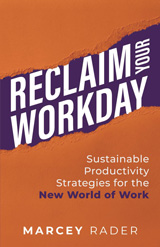
Reclaim Your Workday: Sustainable Productivity Strategies for the New World of Work (Time Management for Manufacturing Leaders) book review by Trevor Blondeel
| Marcey Rader, 2025
Subscribe at manufacturinggreatness.com/subscribe
What This Book Means for Time Management in Manufacturing
For plant managers, operations leaders, and frontline supervisors, the workday rarely gets reclaimed. It gets survived. You walk in with a plan and you spend the next ten hours reacting to the line, the email, the meeting that ran long, the fire nobody saw coming. Most leadership development talks about lean manufacturing and continuous improvement. Almost none of it talks about time management for the person doing the leading. Reclaim Your Workday closes that gap, showing how better focus, fewer meetings, and clearer priorities protect the one resource on the floor nobody schedules maintenance for: your own time.
This is the kind of leadership content we share every month in the Manufacturing Greatness newsletter. Practical book recommendations, leadership tools, and insights built for the shop floor.
What’s It All About?
We protect uptime on every machine in the plant. We build preventive maintenance schedules, we track downtime to the minute, we spend real money keeping equipment running. Then we let the leader run at a hundred percent all day with no maintenance plan at all and wonder why things break down. That is the problem Marcey Rader set out to solve.
Marcey is a keynote speaker, productivity consultant, and four-time author. Her story has weight behind it. She spent years chasing more, more promotions, more certifications, more endurance races, until two preventable medical diagnoses stopped her cold. That was the turning point. She built her whole approach, what she calls health-powered productivity, on the idea that you can be effective without burning yourself down to do it.
Her earlier books were written for the individual. This one is written for the organization. That is what makes it useful for us. She lays it out so an operator, a supervisor, and a plant manager each know exactly what they can do from where they sit.
The Big Idea
The part I keep coming back to is her structure. Every chapter gives you up to three moves for an individual contributor, one to three for a manager, and a level she calls the spaceship view for the owner or the executive, where you change the policy across the whole operation. Same problem, three altitudes.
Think about what that solves on the floor. An operator reads a chapter on focus and can act on it tomorrow without asking permission. A supervisor takes the manager moves. The plant manager makes the call that changes it for everybody. Nobody gets to say "that's not my job" and nobody gets to say "I don't have the authority." Everybody has a move.
She frames the whole book as a buffet. Take what works for you today, leave the rest, come back later. No guilt, no all-or-nothing system you have to swallow whole. For a leader who has been handed one more program to roll out, that permission is the thing that gets it actually used.
Favorite Quote
"If a journalist followed you around all day, would they write that you are living what you say your priorities are, or would your actions tell a different story?"
I have coached leaders who would tell you their top priority is their people, and then you watch their day and it is all email and status meetings. I have been that leader. We say the priority out loud and then the day writes a different story. Marcey's fix is simple and hard at the same time. She caps her clients at three priorities. Not ten. Three. Then she asks them to prove it with their calendar.
Biggest Takeaway
Busy is not the same as productive. We know this in manufacturing better than anyone, because we measure it. A machine running full speed making parts nobody ordered is not productive. It is just busy. The same is true for the leader. A day packed with meetings and a cleared inbox can feel like a good day and move nothing that matters.
Here is where Marcey's work and mine meet. She calls it optics versus outcomes, fixing what is visible instead of what is broken. I call it the difference between tactical and strategic time. Knocking out emails feels good in the moment. But when the day is gone and the important conversation never happened, that cost adds up. The leaders who reclaim their workday are the ones who stop rewarding themselves for looking busy and start protecting the time that actually moves the plant.
Bonus Information
One detail from the book stuck with me. The word multitasking was coined in a 1965 IBM paper to describe a computer, not a person. It was never meant for us. And here is the kicker: even the computer isn't truly doing two things at once. It is switching between tasks fast enough to fake it. When we multitask, we are doing the same thing, just slower and with a cost. Research from Gloria Mark found it can take about twenty-three minutes to fully refocus after an interruption. Run the math on how many times your day gets interrupted on the floor and you start to see where the hours go.
So pick one thing. Protect the block. Treat your own focus like it is a machine worth keeping running, because it is.
You can find Reclaim Your Workday: Sustainable Productivity Strategies for the New World of Work on Amazon.
Subscribe at manufacturinggreatness.com/subscribe
Reviewed by: Trevor Blondeel, June 2026