
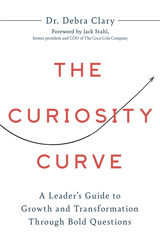
The Curiosity Curve: A Leader’s Guide to Growth and Transformation Through Bold Questions book review by Trevor Blondeel
| Dr. Debra Clary, 2025
What This Book Means for Manufacturing Leaders
For plant managers, operations leaders, and frontline supervisors expected to drive production efficiency, continuous improvement, and team performance, many default to having the answers instead of asking better questions. While leadership development often emphasizes lean manufacturing and operational excellence, The Curiosity Curve shows how curiosity directly impacts employee engagement, problem solving, and decision-making on the shop floor, helping leaders improve communication, build team ownership, and get results that stick.
This is the kind of leadership content we share every month in the Manufacturing Greatness newsletter. Practical book recommendations, leadership tools, and insights built for the shop floor.
Subscribe for free at manufacturinggreatness.com/subscribe
What’s It All About?
What if the most powerful leadership skill isn’t having the answers? What if it’s knowing which questions to ask? That is the core idea behind The Curiosity Curve by Dr. Debra Clary. Debra started her career at 4 a.m. loading Frito-Lay trucks in Detroit, worked her way through senior leadership roles at Coca-Cola, Jack Daniel’s, and Humana, earned her doctorate from George Washington University, and commissioned MIT researchers to study the connection between curiosity and team performance. What they found confirmed what she had always believed: leaders with high curiosity levels have teams with significantly higher performance.
This is a book about how curiosity is not a personality trait you either have or don’t. It is a skill. One that can be built, practiced, and embedded into the culture of your organization.
The Big Idea
Here is something I did not expect to read: manufacturing attracts curious people. Engineers want to understand how things work. Technicians want to know why a machine is failing. New hires come in asking questions. The curiosity is already there. But then the pressure sets in. Leaders are measured on parts per hour. The structure demands compliance, not questions. And slowly, curiosity gets squeezed out.
Debra calls this the curiosity gap: the growing distance between the curiosity we need and the curiosity we actually have. The fix is not complicated, but it is intentional. The decision to be curious remains ours to make. When you shift from telling to asking, something changes. It is no longer your strategy. It becomes the team’s plan.
Favorite Quote
“Most of us have become so focused on having the answers, we’ve forgotten to ask the questions.”
That line kept coming back to me. Because I have lived it. I have been in meetings where I had the answer before anyone finished speaking. I have coached leaders who do the same thing. And what Debra shows is that when you already have the answer, you are not leading anymore. You are just directing. There is a difference.
Biggest Takeaway
Curiosity is not just good for the individual leader. It flows through the organization. Every team member is a link in a stream of continuous improvement. When they are curious, they find the problems before the problems find you. Debra’s research, backed by a meta-analysis of over 200 studies, shows that curiosity is just as influential as intelligence in driving achievement.
And there is a simple way to start. Stop asking questions that already have your answer baked in. Instead of “Don’t you think we should increase cycle time on line six?” try “Where do you see us losing the most time on that line?” It is the difference between leading a witness and getting out of your teammate’s way.
Bonus Information
Albert Einstein once wrote to his biographer: “I have no special talents. I am only passionately curious.” The old saying is curiosity killed the cat, but the full version continues: satisfaction brought it back. According to Gallup, employee disengagement now costs the global economy an estimated 8.9 trillion dollars. Curiosity is not a soft skill. It is a business strategy. Curiosity without follow-through is just restlessness. The goal is to ask better questions and then actually do something with the answers.
Subscribe at manufacturinggreatness.com/subscribe
Reviewed by: Trevor Blondeel, September 2025