
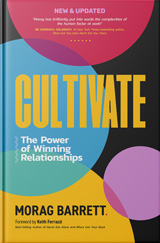
Cultivate: The Power of Winning Relationships book review by Trevor Blondeel
| Morag Barrett, 2014, revised 2025
What This Book Means for Manufacturing Leaders
In manufacturing, where operations managers and production managers are under pressure to improve manufacturing productivity, manage labor shortages, and lead through constant change, breakdowns in relationships often become the hidden constraint. While many organizations focus on process optimization and production management systems, Cultivate shows how strong relationships affect communication, accountability, and team performance, helping leaders strengthen trust and get more consistent results on the shop floor.
This is the kind of leadership content we share every month in the Manufacturing Greatness newsletter. Practical book recommendations, leadership tools, and insights built for the shop floor.
Subscribe for free at manufacturinggreatness.com/subscribe
What’s It All About?
When I think about the challenges we face in manufacturing, one word comes to mind: disconnect. Even in environments with strong systems and processes, performance suffers when relationships break down. When we are truly connected, expectations are clear, accountability builds trust, and that trust is visible and consistent.
Morag Barrett draws you in with the revised edition of Cultivate. She provides a clear framework and introduces four relationship types that help you assess and improve how you work with others. This is not about being nice and ignoring results. It is about building real relationships that strengthen trust, improve how we communicate, and lead to better outcomes. Barrett breaks relationships into four categories: the Ally, who has your back and balances encouragement with tough love. The Supporter, who is in your corner and offers feedback when you ask. The Rival, who creates friction that requires strong communication. And the Adversary, the most challenging, and often a source of stress if left unaddressed.
The Big Idea
The book is filled with practical scripts you can use right away. One story that stands out is about David, who chose courage over avoidance and had a direct, vulnerable conversation to clear the air. That moment changed the relationship. It is a good reminder that the conversations we avoid are usually the ones that matter most.
Barrett also introduces a relationship pulse check with two simple questions: What is working well between us? What is getting in the way of our success? Those two questions alone can shift a conversation from small talk to something that matters. In manufacturing, where we are measured on output and efficiency, it is easy to skip those conversations. But skipping them is how the disconnect grows.
Favorite Quote
"Neutral relationships are valued as positive, when in fact the opposite can be true."
We assume that if a relationship is not bad, it must be fine. And if it is fine, it must be positive. But that is the trap. The neutral ones are often where your intentions are not matching their perceptions. You think everything is good because nobody is telling you otherwise. And maybe that is because you do not seem open to hearing it. I used to think everybody liked me. I know now that is not true. And looking back, I had opportunities to check in on those relationships and how I was showing up. I did not take them.
Biggest Takeaway
When relationships feel neutral, it is easy to focus only on the work. But that often leads to protecting your responsibilities, covering your bases, and prioritizing output over connection. I have been described as a bull in a china shop. I got results, but sometimes at the expense of others. My drive for execution left a negative impact on the people around me. Looking back, that is not real success.
Success that damages trust and relationships is not worth it. And this ties right back to the Showing Up Gap. You think you are showing up fine because nobody is telling you otherwise. But the gap between your intentions and how others experience you is where relationships quietly break down.
Bonus Information
You are not alone in experiencing relational friction at work. Barrett’s book helps you feel grounded in where you are and confident that you can do something about it. For leaders dealing with labor shortages, skills gaps, and constant change, investing in relationships is not an event. It is just how you show up. The four relationship types give you a language to talk about what is happening on your team, and the pulse check gives you a place to start.
To learn more with Morag Barrett, listen to Episode #169 of the Manufacturing Greatness podcast.
Subscribe at manufacturinggreatness.com/subscribe
Reviewed by: Trevor Blondeel, January 2025